
Are ADUs Catching On in NYC? Here’s What the Data Says So Far (Updated September 2026)
Key Takeaways
- 300 total ADU projects, filed as 321 applications, are on record with NYC DOB as of August 31, 2026 — July set the record with 40, and August added 27.
- Queens leads with 191 applications (60%) and Staten Island is second with 69 (21%); Manhattan is no longer at zero, with two basement or cellar units filed in May 2026, both in objections.
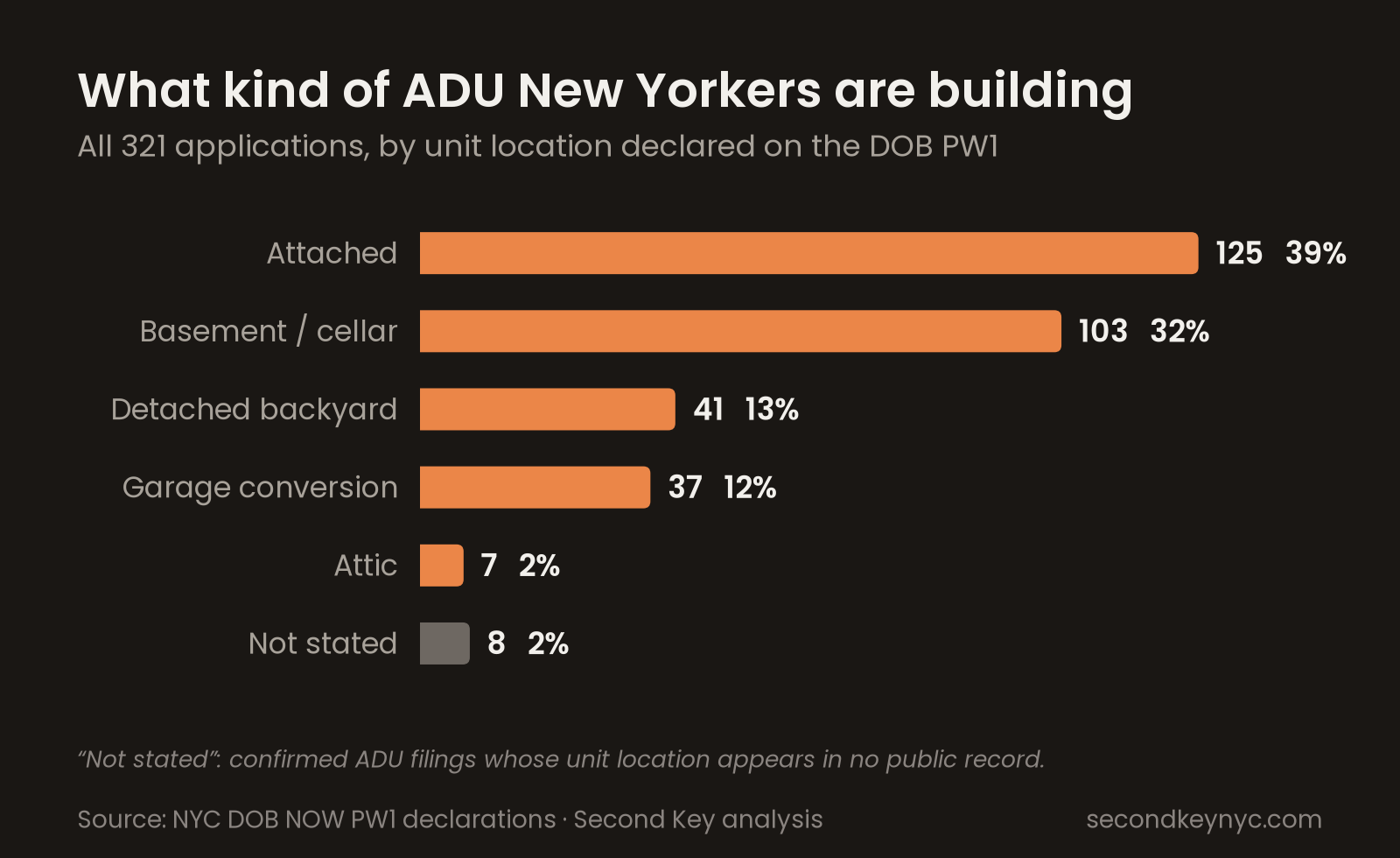
- Attached ADUs lead at 39%, subgrade (basement and cellar ADUs) follows at 32%, and detached backyard and garage are 13% and 12%; 178 of the 321 are new buildings or rebuilds.
- 79 applications have pulled a construction permit, but no ADU project in NYC is complete yet; 124 (39%) are in objections, the program's real bottleneck.
- Declared costs on the ADU application span under $50,000 to over $1 million, with a median of $191,000, showing ADUs draw homeowners across the budget spectrum, not just investors.
New York City's Accessory Dwelling Unit (ADU) rules took effect in June 2025, and the Department of Buildings began accepting ADU applications on September 30, 2025. For the first time, homeowners across the five boroughs can legally build backyard cottages and convert basements, garages, and attics into separate dwelling units.
The big question: are property owners actually building ADUs?
When we first published this analysis in March 2026, the earliest applications were still in plan review. Analyzing the DOB filing data nearly six months later, two things stand out: the filing pace is still rising, and 79 ADU applications are associated with active construction permits.
As of August 31, 2026, there are 300 total ADU projects on record with DOB. July set a record with 40 new applications, and August added 27 more.
Since last month. Between July 31 and August 31, the total number of ADU projects filed in NYC increased by 39, and applications increased by 41: 27 new filings in August, and 14 previously-filed applications were verified as ADUs. Applications with an active construction permit rose from 61 to 79. Staten Island added 10 applications and the Bronx added 9. Basement and cellar ADUs grew by 17 applications and attached ADUs grew by 15. The median declared cost increased from $181,000 to $191,000, and no ADU in the city has a certificate of occupancy yet.
What is an Accessory Dwelling Unit (ADU)?
An ADU is a secondary housing unit on a residential property. In New York City, the ADU program allows 1- and 2-family homeowners to add a legal, self-contained dwelling unit to their property — complete with its own entrance, kitchen, and bathroom.
ADUs in NYC can take several forms:
Detached ADUs: A fully separate structure built in the backyard
Attached ADUs: A new addition built onto the rear, side, or top of your home
ADU Garage Conversions: Transforming a garage into living space
Subgrade ADUs: A legal apartment in a basement or cellar, either converted or built with a new home
Attic ADUs: Finishing and converting attic space into a livable unit
The benefits are significant: rental income from a legal tenant, increased property value, housing for aging parents or adult children, and a contribution to New York's housing supply. New York City's ADU program was created for 1- and 2-family homeowners — the backbone of housing in Queens, Staten Island, the Bronx, and parts of Brooklyn.
NYC ADU Filings at a Glance
Total ADU projects: 300 distinct projects and 321 applications (as of August 31, 2026)
Most popular borough for ADUs: Queens (60% of all applications)
Most popular ADU type: Attached (39%), with subgrade (basement and cellar ADUs) close behind (32%)
DOB-approved ADU applications: 101, including 79 with active permits
Insight #1: The Filing Pace Is Still Rising
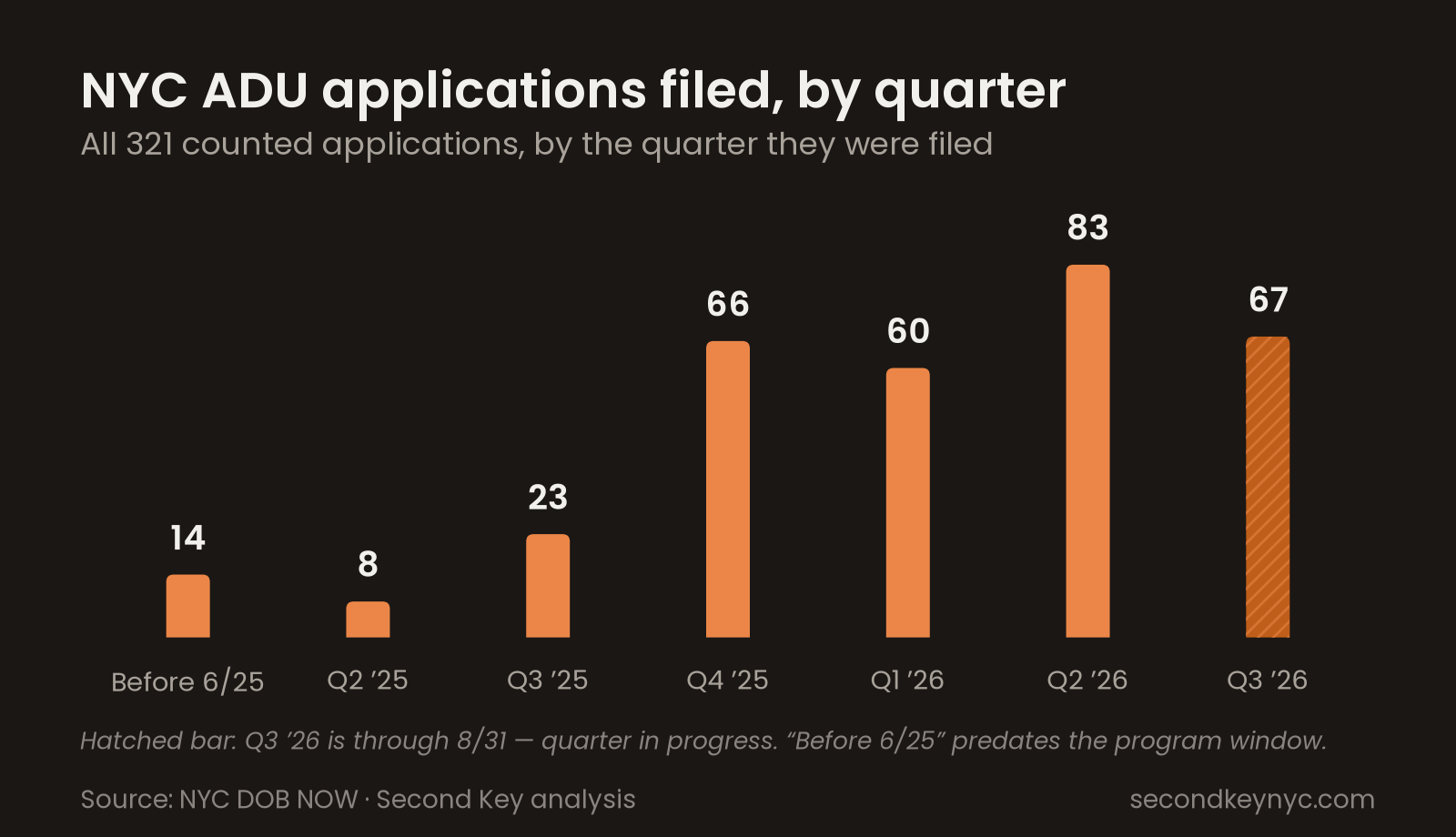
The second quarter of 2026 was the busiest full quarter since the program launched, with 83 new applications. July produced 40 on its own, the highest single month on record, and August followed with 27. Monthly volume has stayed between 14 and 40 every month since October 2025.
Insight #2: Queens Still Leads, Staten Island Is Gaining, and Manhattan Is No Longer at Zero
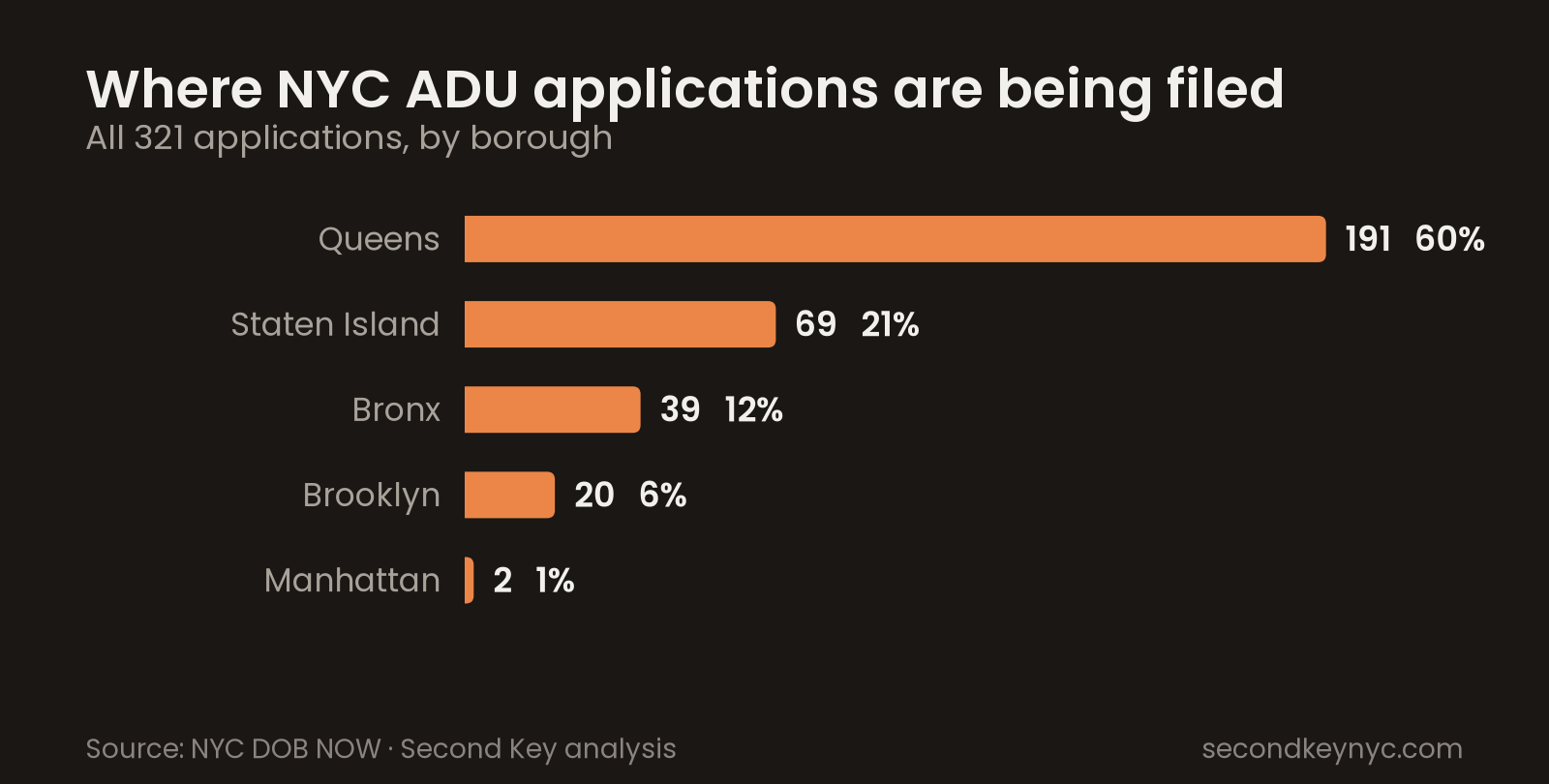
Of the 321 ADU applications filed citywide, 191 came from Queens: 60% of the total. Staten Island is a clear second with 69 (21%), and its share has grown since March. The Bronx (39) and Brooklyn (20) trail. Manhattan, which had zero filings in our March data, now has two, both basement or cellar units filed in May 2026 with DOB objections.
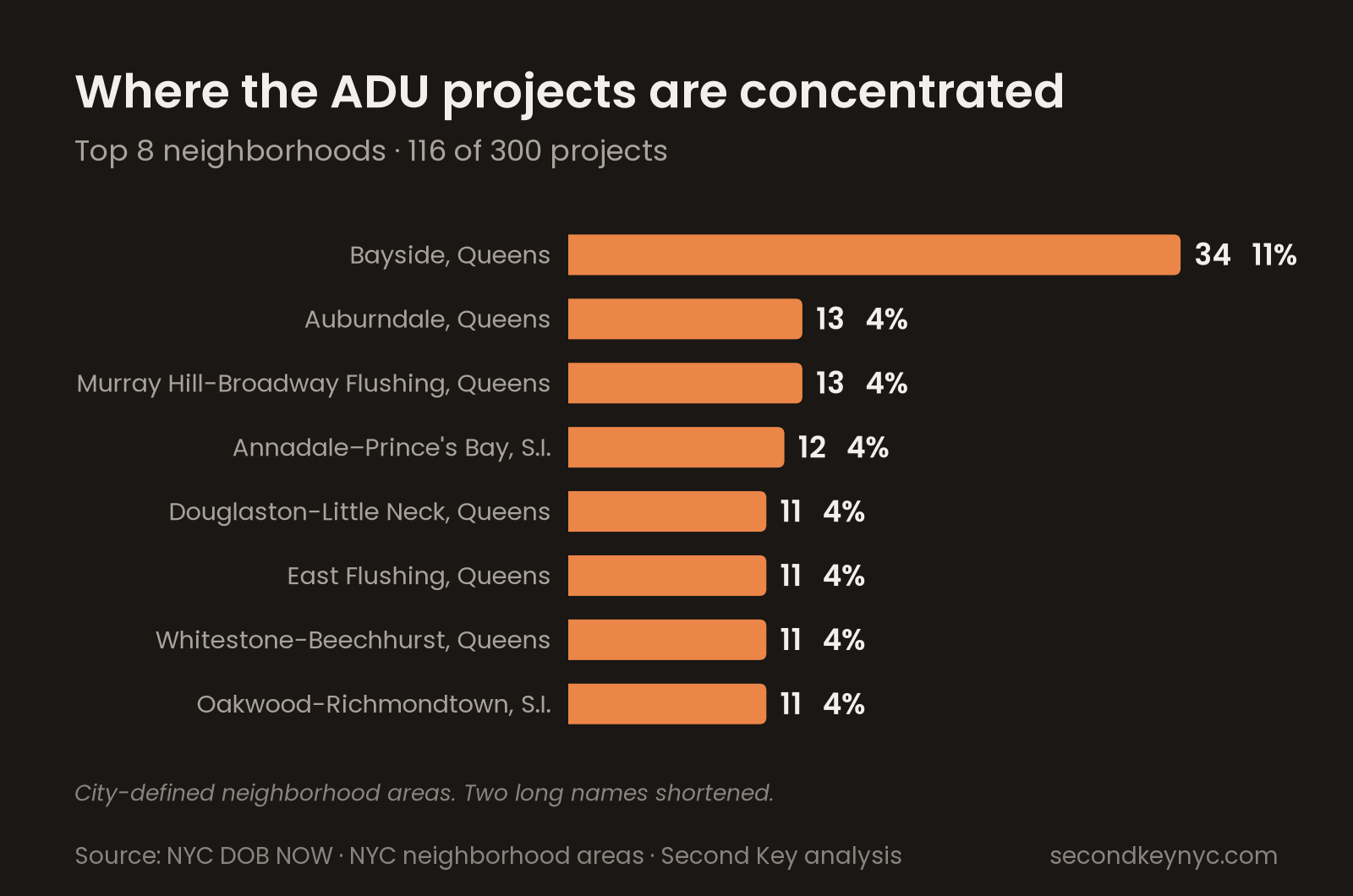
The pattern is sharper at the neighborhood level. Bayside in Queens leads with 34 projects, more than double any other area, and the rest of the top eight sit in eastern Queens and along Staten Island's east and south shores. Those eight neighborhoods account for 116 of the 300 projects. If you own a 1- or 2-family home in one of them, some of your neighbors have already filed.
Insight #3: Permits Are Being Issued
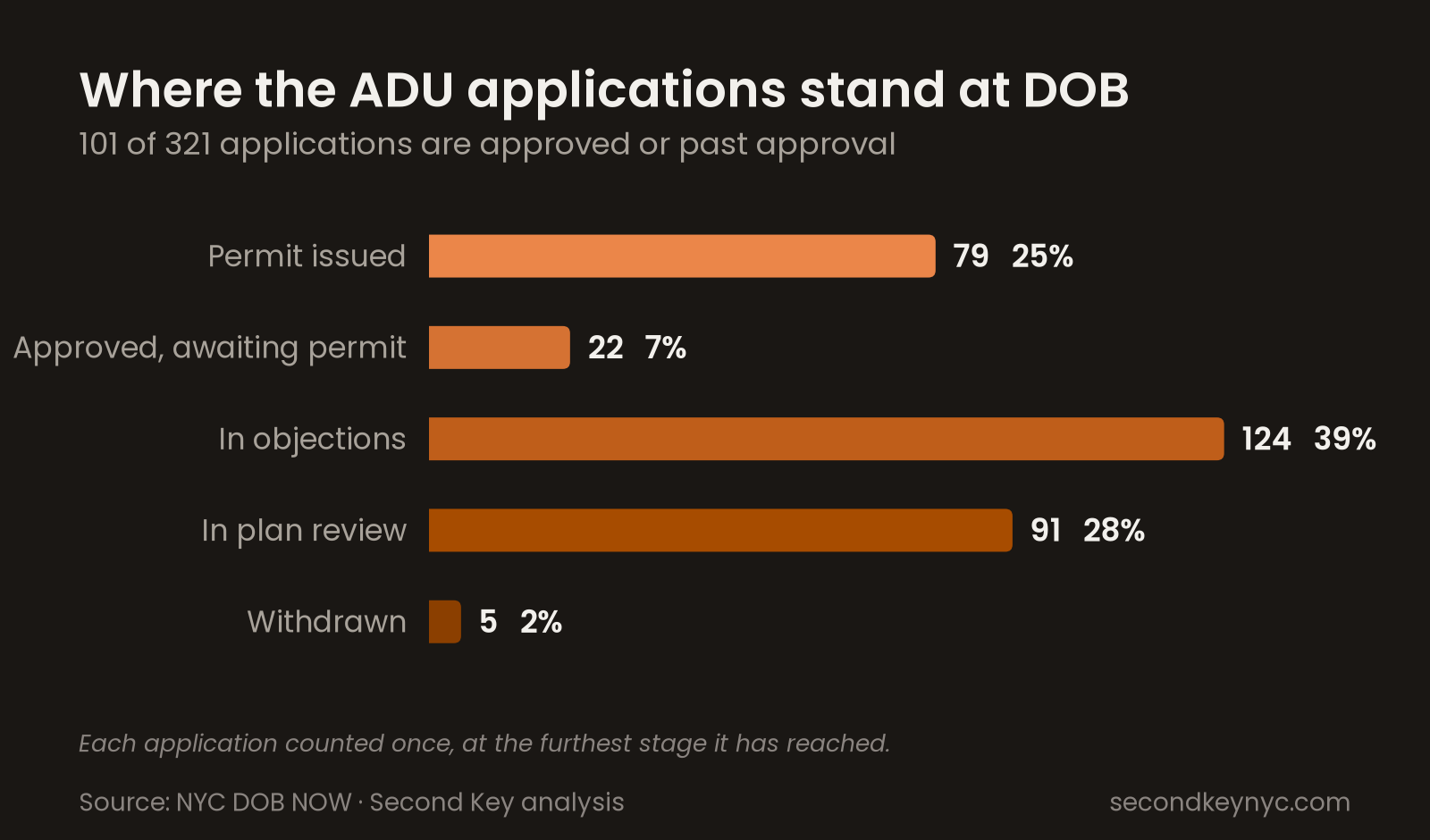
This is the strongest development since March. When the original post ran, only 8 applications citywide had reached approval. As of August 31, 101 applications (31%) are approved, and 79 of them have pulled at least one construction permit.
As of August 2026, there are no completed ADU projects in NYC. The first one is the next milestone, and we will report it here.
The bottleneck hasn't changed: 124 applications (39%) are in objections, meaning DOB plan review found issues that must be corrected before approval — nearly the same share as in March. An objection is not a rejection, and it's common knowledge in the industry that DOB plan examiners issue objections for nearly every major job filing.
Five total ADU applications have been withdrawn, only one of which was refiled under a different application number.
Insight #4: The ADU Type Mix Is More Balanced Than We First Reported
Attached ADUs, meaning additions built onto the rear, side, or top of the house, still lead at 125 applications (39%). That is well below the 54% we reported in March. The correction comes from reading each applicant's own PW1 declaration of where the unit is, rather than inferring it from the job description.
The updated ADU configuration mix: 125 attached, 103 subgrade (32%), 41 detached backyard, 37 garage, and 7 attic. Eight confirmed ADU applications state no unit location in any public record. Basement and cellar ADUs are a much bigger share than we first reported, and detached backyard units, nearly absent from our March count, are now an established category.
One more interesting finding: 111 of the 321 applications are new building jobs, and another 67 rebuild an existing structure into a new home. Developers and investors are designing ADUs into brand-new 1- and 2-family homes from the start, especially on Staten Island.
Insight #5: ADUs Are Being Built at Every Price Point
Of the 209 ADU applications that declare an estimated cost, the average is about $441,000 and the median is $191,000. A small group of new building projects pulls the average roughly $250,000 above the typical filing, which makes the median the better guide.
One caveat matters more than either figure: these are the costs declared on the ADU application itself. Plumbing, sprinkler, electrical and, for the most part, mechanical work is filed with DOB separately, each filing carrying its own declared cost, so the all-in cost at most of these addresses is higher than the number here.
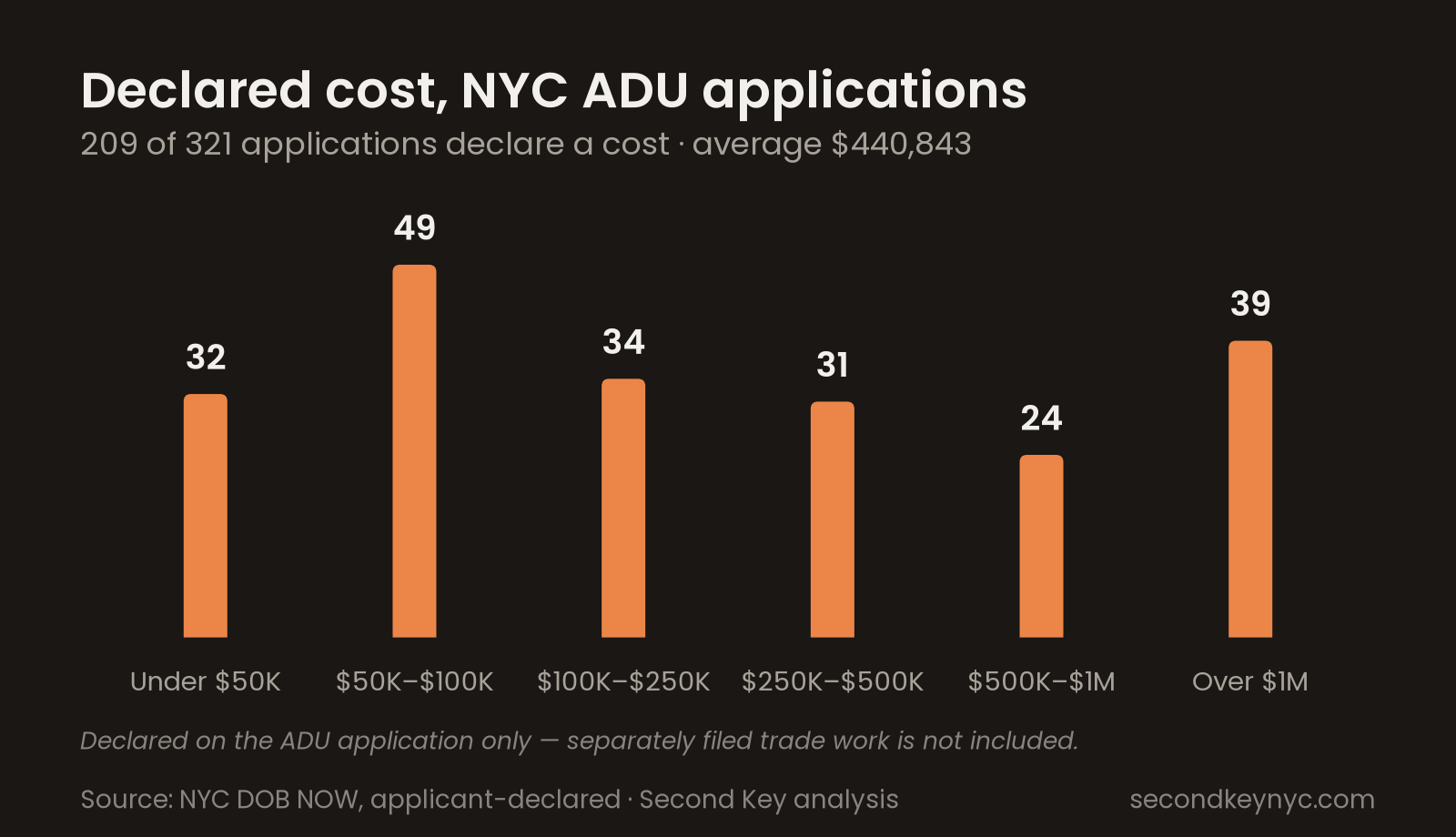
The declared costs are spread across the range: 32 applications under $50,000, 49 between $50,000 and $100,000, 34 between $100,000 and $250,000, 31 between $250,000 and $500,000, 24 between $500,000 and $1 million, and 39 above $1 million.
The takeaway from March still holds. NYC homeowners across the budget spectrum are moving forward with ADUs, not just deep-pocketed investors.
A Note on the Data
Where these numbers come from: every figure on this page is derived from New York City's own published records — DOB NOW job application filings, approved permits, and certificates of occupancy on NYC Open Data. We review each record individually and verify it against the information on its DOB PW1 form wherever the form asks the question. Roughly 40 older filings predate the question and are classified as ADUs based on their job descriptions.
Projects and applications are different counts: related applications on the same property, meaning refilings and companion structures, are grouped and counted as one project: 321 applications, 300 distinct projects. Follow-on filings at ADU sites, such as plumbing or fence permits, are excluded from the total ADU project count. Our NYC ADU Project Map plots the 300 projects.
Dates: filing dates are DOB NOW initial filing dates.
Approval isn't guaranteed: applications in objections may be corrected, withdrawn, or abandoned. Withdrawn applications stay in the application count, the same convention the March post used, but are excluded from the ADU project count. We will keep updating this page as ADU filings move through DOB plan review.
Self-reported costs: costs are declared by the applicant on the ADU application and are not verified at filing. They represent stated intent, not final construction spend, and they cover only the work on that one application — plumbing, sprinkler, electrical, and (usually) mechanical work is filed separately, each with its own declared cost, and none of that is added in. The all-in project cost is therefore higher than the figures here. For new buildings that include an ADU, there is also no way to isolate how much of the declared cost belongs to the ADU rather than the house.
Thinking About an ADU on Your NYC Property?
The data is clear: New Yorkers are building ADUs, Queens is leading, and 61 applications already have active construction permits. A free ADU assessment will show you what you can build on your property and roughly how much it will cost. There are no obligations and no sales pressure — just a clear picture of your options.