
ADU Ideas for NYC Homes - Granny Flats, In-Law Suites & More
Living in New York City is an amazing experience, but often comes with sacrificing space. If you're lucky enough to have a basement, a garage, or even a small yard, you're sitting on more potential than you might realize.
Since NYC legalized ADUs under the City of Yes housing plan and Local Law 127 in 2024, homeowners across Queens, Brooklyn, the Bronx, and Staten Island have a new option: convert existing space (or build new) into a legal rental unit that generates real income or gives your family room to grow. Here are the most popular ADU types — and how to figure out which one is right for your property.
Basement Brilliance
In NYC, the basement or cellar ADU is an excellent option with the most bang for your buck. Tens of thousands of homes across the outer boroughs have basements that are either unused, underused, or already being rented informally.
Under Local Law 126, some existing basement apartments can now be legalized — bringing them up to code without a full rebuild. Under Local Law 127, new basement ADUs can be permitted as of late 2025.
What makes a good basement ADU:
Ceiling height of at least 7 feet (8 feet preferred after renovation)
Enough square footage for a livable studio or 1-bedroom (typically 350–600 sq ft)
Access to natural light through egress windows
A separate entrance from the exterior
Basement studios in Queens and Brooklyn rent for $1,800–$2,400/month. With a quality renovation running $100,000–$175,000, payback periods are typically 5–7 years.
The Backyard Granny Flat (Yes, Even in NYC!)
Even a small backyard of 15×20 feet can become a detached ADU — and in NYC, these are the most valuable ADU type when done right.
A backyard cottage is fully separate from the main home, giving both the homeowner and the tenant maximum privacy. It can be purpose-built from scratch or assembled using pre-approved designs from the city's ADU for You platform, which can cut design and permitting time significantly.
Best suited for: Queens and Staten Island lots with detached rear yards. Less common in Brooklyn due to smaller lot sizes, but still possible.
Typical size: 400–800 sq ft
Typical rent: $2,200–$3,500/month
Typical build cost: $175,000–$300,000+
The Garage Makeover
This is one of the most cost-effective ADU options available in NYC because the structure already exists. Garage conversions often avoid the expense of building a foundation, framing, and roofing from scratch.
A typical detached garage conversion involves insulation, flooring, electrical, plumbing, and HVAC — transforming a drafty storage space into a livable studio or 1-bedroom unit.
Best suited for: Properties in Queens, Staten Island, and parts of Brooklyn and the Bronx with detached garages. Attached garage conversions are more complex due to shared walls with the main home.
Typical size: 300–500 sq ft
Typical rent: $1,700–$2,500/month
Typical conversion cost: $100,000–$175,000
Keep in mind: if the garage currently has a car, you'll lose that parking space. For some families, this is a non-starter. For others, the additional income more than offsets the inconvenience.
The Lofted Dream
Less common than basements or garages but worth considering for properties where other options aren't available. Attic ADUs require adequate ceiling height (minimum 7 feet over at least half the floor area), proper staircase access, and structural review.
The major costs in an attic conversion are often dormer additions (to create headroom and windows) and staircase installation. These can add $30,000–$60,000 to the project.
Best suited for: Detached homes in Queens or Staten Island with pitched roofs and substantial attic space.
Pro tip: Use sloped ceilings to your advantage. Built-ins, desks under eaves, and platform beds make every inch count without feeling cramped.
How to Choose the Right ADU Type for Your Property
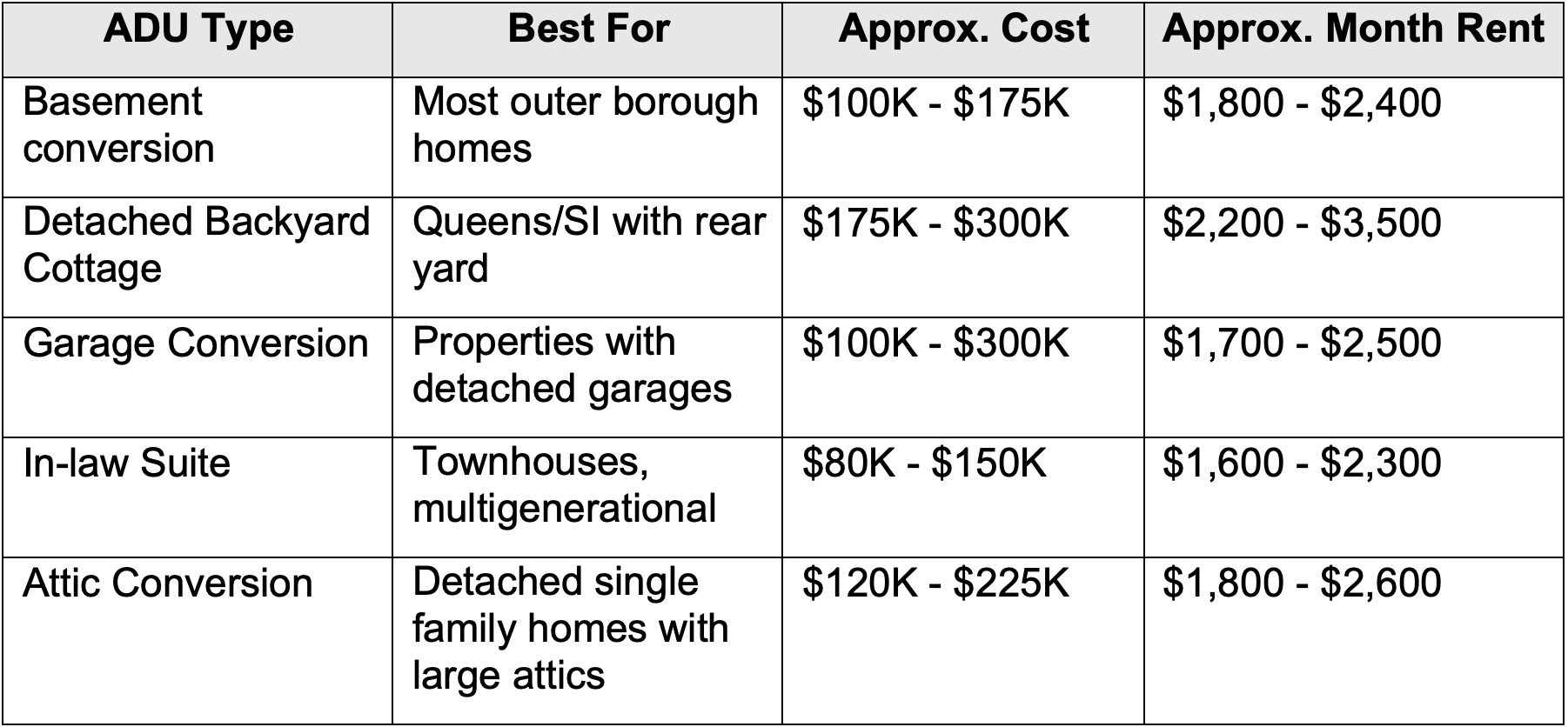
The right choice depends on your property's layout, lot size, zoning district, and what you plan to use it for. Once you have a type in mind, run the numbers through the NYC ADU ROI Calculator to see what the cash flow and payback period look like for your situation.
Why Now is the Time
The housing crisis is real. Families are living together again. Hybrid work has changed how we use our homes. With new laws supporting legal ADU construction, we finally have a framework for building smarter.
At its core, an ADU isn’t just a practical solution - it’s a reflection of how we adapt, connect, and create spaces that grow with us.